


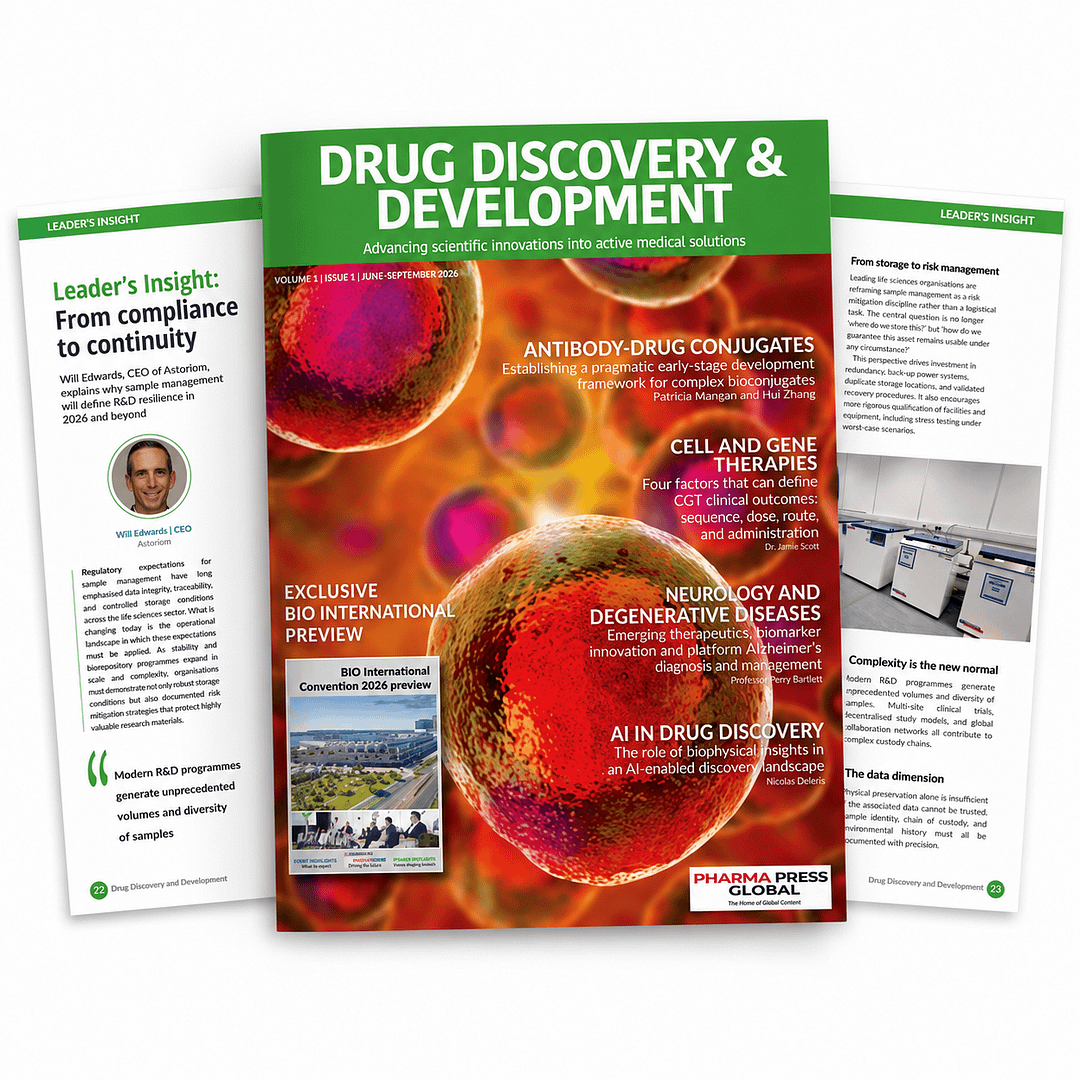

From Compliance to Continuity
Why Sample Management Will Define R&D Resilience in 2026 and Beyond
This article was originally published in Drug Discovery and Development Volume 1 Issue 1 June-September 2026 as part of the Leaders Insights section.
Regulatory expectations for sample management have long emphasised data integrity, traceability, and controlled storage conditions across the life sciences sector. What is changing today is the operational landscape in which these expectations must be applied. As stability and biorepository programs expand in scale and complexity, organizations must demonstrate not only robust storage conditions but also documented risk mitigation strategies that protect highly valuable research materials.
As modern pipelines become more complex, from biologics to cell and gene therapies, the risks associated with sample loss, degradation, or data gaps grow significantly. A single compromised batch of stability samples can delay regulatory filings by months or even years. Lost clinical specimens may invalidate entire study cohorts. For advanced therapies, where materials are often irreplaceable and patient-specific, the consequences are even more profound (Alliance for Regenerative Medicine, 2025). In this context, sample management is no longer about storage capacity: it is about continuity.
Rising regulatory scrutiny
Global regulators are increasingly focused on demonstrable control across every stage of the sample lifecycle. Current guidance and inspections emphasise data integrity, traceability, environmental control, and documented risk management (FDA, 2018) (ICH, 2008). Pharmaceutical quality systems are expected to keep track from development through commercialization, including outsourced activities (ICH, 2008).
Environmental monitoring and contamination control have also received heightened attention. Updated GMP guidance stresses the need for validated monitoring systems, risk-based controls, and comprehensive documentation to demonstrate that storage conditions remain within defined limits (European Commission, 2022). In parallel, storage and distribution standards emphasise preserving product quality through controlled conditions and traceable handling practices (www.who.int, n.d.).
Complexity is the new normal
Modern R&D programs generate unprecedented volumes and diversity of samples. Multi-site clinical trials, decentralized study models, and global collaboration networks all contribute to complex custody chains. Samples may travel across continents, move between laboratories, and remain in storage for many years before analysis.
At the same time, temperature requirements are becoming more demanding. Programs frequently span controlled room temperature, refrigerated, frozen, ultra-low, and cryogenic conditions (ICH, 2003) (isber.org, n.d.). Retaining integrity across these environments requires a strong infrastructure, rigorous validation, and highly trained personnel.
The growth of personalized medicine further complicates the landscape. Autologous therapies often involve small batches tied to individual patients, leaving no margin for error. Loss or degradation of these materials may eliminate the opportunity for treatment altogether (Center for Biologics Evaluation and Research, 2019) (EMA, 2018). As a result, sample storage is inextricably linked to the success of modern therapeutic development.
From storage to risk management
Leading life sciences organizations are reframing sample management as a risk mitigation discipline rather than a logistical task. The central question is no longer “Where do we store this?” but “How do we guarantee this asset remains usable under any circumstance?”
This perspective drives investment in redundancy, backup power systems, duplicate storage locations, and validated recovery procedures. It also encourages more rigorous qualification of facilities and equipment, including stress testing under worst-case scenarios. Forward-thinking organizations are going as far as adopting geographically separated storage strategies to reduce exposure to regional disruptions (NIST, 2024).
Documentation plays an important role. Regulators want clear evidence that risks have been evaluated and that mitigation plans are both implemented and tested. Demonstrating operational readiness is essential.
The data dimension
Physical preservation alone is insufficient if the associated data cannot be trusted. Sample identity, chain of custody, and environmental history must all be documented with precision. Any ambiguity undermines scientific validity and regulatory confidence (FDA, 2018).
Digital transformation is therefore reshaping sample management. Advanced inventory systems, automated monitoring, and electronic audit trails enable organizations to keep real-time visibility across distributed networks. These tools reduce manual handling, minimise transcription errors, and provide rapid access to information during inspections or investigations.
Artificial intelligence is beginning to play a role as well, particularly in predictive maintenance and irregularity detection. By analysing historical data, AI systems can identify patterns that precede equipment failures or environmental excursions, allowing proactive intervention (ISPE | International Society for Pharmaceutical Engineering, 2026). While adoption is still evolving, the potential to prevent incidents before they occur aligns with the industry’s shift toward preventive quality management.
Outsourcing as a strategic choice
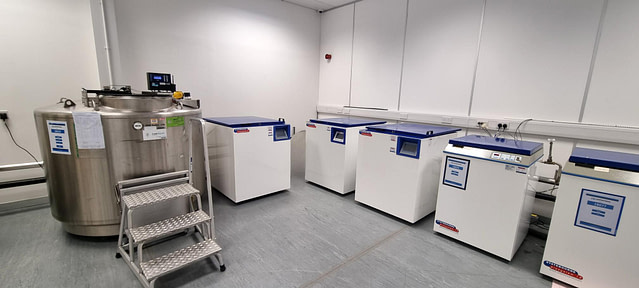
Many organizations are recognizing that building and maintaining modern storage capabilities internally can be resource intensive and operationally complex. Dedicated external partners like Astoriom often provide specialized infrastructure, validated processes, and experienced personnel that would be difficult to replicate in-house.
Outsourcing also offers scalability. As pipelines expand or contract, storage requirements can change dramatically. Flexible external capacity allows companies to adapt without major capital expenditure. Additionally, independent providers can offer business continuity advantages, particularly when they operate multiple sites with built-in redundancy.
Preparing for the unexpected
Recent global events have underscored the vulnerability of complex supply chains and infrastructure. Extreme weather, geopolitical tensions, and energy instability can and do disrupt operations (Center for Biologics Evaluation and Research, 2019).
Organizations that invest in preparedness are better positioned to withstand these shocks. This includes not only technical safeguards but also trained personnel, clear communication protocols, and rehearsed response plans. The goal is to retain control even when normal conditions are disrupted.
Resilience also supports sustainability. Preventing sample loss reduces the need for repeat studies, conserving resources and minimizing environmental impact. As the industry pursues net zero targets, efficient use of existing materials becomes increasingly important (Science Based Targets, 2024).
Looking ahead
Sample management is evolving from a background function into a strategic enabler of scientific progress. Companies that treat it as a core component of their quality ecosystem will be better positioned to navigate regulatory scrutiny, technological change, and operational uncertainty.
In the next few years, success will depend on integrating infrastructure, data systems, quality processes, and risk management into a unified approach. This integration ensures that samples remain reliable assets rather than potential points of failure.
Ultimately, the integrity of research outcomes, regulatory approvals, and patient treatments depends on the integrity of the materials behind them. Protecting those materials is not merely a technical challenge; it is a commitment to scientific credibility and public trust.
Organizations that move beyond minimum compliance and embrace proactive continuity planning will set the standard for the next era of life sciences innovation. In a world where each sample may represent years of work and the hopes of patients, safeguarding them is not optional.
How does Astoriom support organizations?
Astoriom supports organizations across the pharmaceutical, biotechnology, medical device, research, cosmetics, food and beverage, consumer products and packaging sectors with contingency storage, temperature-controlled transport and disaster recovery services for stability samples, biological materials, clinical research collections and other temperature-sensitive materials.
Astoriom provides storage across ambient, refrigerated, frozen, ultra-low temperature and cryogenic conditions, supported by established quality systems, monitoring and geographically distributed facilities.
By combining specialist storage infrastructure, transport capability and sample management experience, Astoriom helps organizations protect sample integrity, maintain documentation and reduce disruption to research, development and manufacturing programs.


