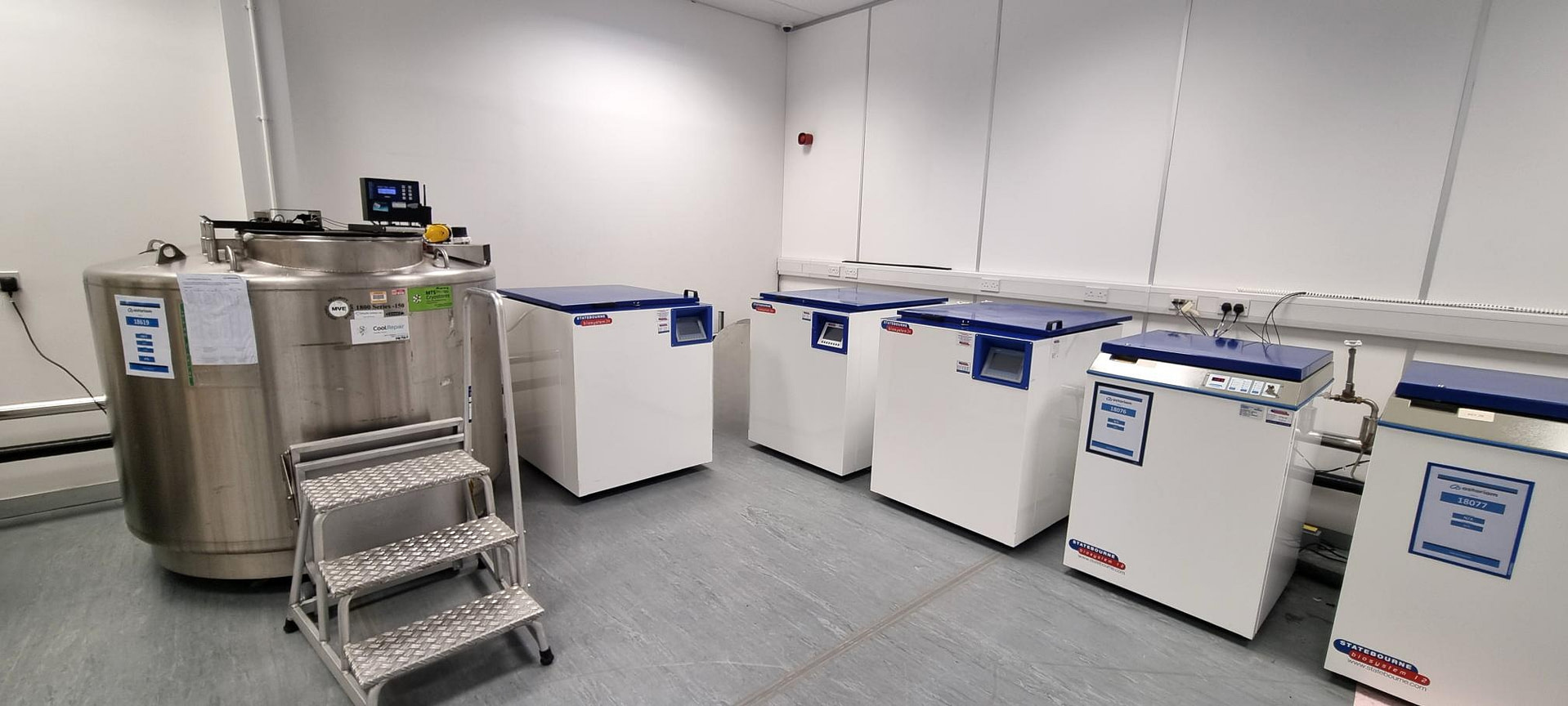
Best Practice Guidance for Biorepository and Sample Stability Storage
Contents
- The Critical Role of ICH Sample Stability in Life Science Innovation
- Best Practice Solutions for Biorepository Storage and Sample Stability: Astoriom Sample Storage Resources Guide
- Sustainable Sample Management Storage Strategies
- The Value of an Integrated Sample Storage Partner
- Choosing a Sample Storage Solutions Partner to Protect Research Assets from Discovery to Post-Market
Executive Summary
The success of drug development, advanced therapies, and medical device development depends on one often-overlooked factor: stability and secure, temperature-controlled storage of discovery, clinical research and product manufacturing samples. As innovation accelerates in precision medicine, cell and gene therapies (CGTs), oncology research and increasingly complex global clinical trials, the safeguarding of these assets has become increasingly critical.
The stakes are high. A single storage failure can derail years of research and development investment, delay regulatory submissions, and undermine patient trust worldwide. The risk is compounded by escalating costs, often fragmented biorepository and stability storage systems that make oversight difficult given stringent international and country-specific regulatory demands and variances (e.g. ISO, ICH, GxP, FDA, EMA). In addition, guidance on best practices comes from many differing organizations often depending on the type of sample, research purpose and planned length of storage (e.g. WHO, FDA, NIH, CDC, EMA, ISBER and a host of research specific organizations). Together, these pressures make robust, future-ready sample storage and stability management a strategic necessity. However, the path to the optimum storage solution can often be time-consuming and difficult to identify.
This whitepaper examines the challenges faced by researchers, scientists, pharma and biotech sponsors, CROs, CDMOs, and regulatory teams across the research and development lifecycle. It presents a summary of best practices gathered from many respected industry sources and highlights strategic considerations for storage, disaster recovery, sustainability, and regulatory alignment. Central to this is the Astoriom Best Practice Resources Guide– a practical framework that distils global guidance into actionable sample storage considerations for biologics, advanced therapies, drugs and medical devices.
What You’ll Learn in This Whitepaper
- Why ICH sample stability testing and secure storage are mission-critical to research advancement and the most common challenges.
- What best practice frameworks and risk assessment tools exist and how to leverage them to identify vulnerabilities and strengthen your storage strategy.
- How to embed sustainability and regulatory alignment into modern biorepository management strategies to future-proof your research.
- Understanding the value of integrated sample stability and biorepository storage in creating research efficiencies that optimize resources and accelerate research.
- The benefits of outsourcing to a specialist partner like Astoriom to reduce risk, ensure compliance, and support scalability.
The Critical Role of ICH Sample Stability in Life Science Innovation
Behind every life-changing therapy lies a foundation of biological and chemical samples: blood, plasma, tissues, engineered cells, vaccines, and stability batches. Their integrity directly affects regulatory approval, patient safety, and return on investment (ROI).
The cost of failure
- Lost samples: irreplaceable in personalized medicine and advanced therapies.
- Regulatory non-compliance: leads to costly rework or rejection of submissions.
- Delayed trials: extends time-to-market and increases patient risk.
- Financial loss: According to research published in American Journal of Health-System Pharmacy, temperature excursion failures lead to annual losses exceeding $35 billion across the biopharma industry.
Common Challenges in Biorepository and Stability Sample Storage
- Inconsistent storage practices across laboratories and contract research organizations (CROs).
- Fragmented oversight across multiple sites.
- Inadequate temperature monitoring and validation.
- Regulatory diversity across countries and organizations (ICH, FDA, EMA, MHRA, ISO, etc.) including sometimes inconsistent and contradictory best practice guidelines (ISBER, WHO, HTA, COE, AABB, CLSI, FACT, GxP, cGMP).
- Insufficient disaster recovery and business continuity plans.
- Poor packaging and transport logistics.
- Limited scalability as pipelines expand.
Sample Storage Challenges Across the Drug Development Lifecycle
Each phase of product development has distinct storage requirements:

Considerations Checklist for Lifecycle Planning
✔ Identify sample types and volumes expected at each stage
✔ Map required storage temperatures and durations
✔ Align protocols to meet regulatory requirements (ICH, ISO, GxP, FDA, EMA, etc.)
✔ Consult industry best practice guidelines (e.g., ISBER, WHO and specialty associations)
✔ Budget for storage as part of program costs
✔ Plan disaster recovery at each stage — not just late in development
Case Study: Space & Capacity Constraints
A pharmaceutical client conducting a single-dose study with an Active Pharmaceutical Ingredient (API) required stability testing across thousands of samples at multiple temperatures and time points. Their in-house chambers lacked the necessary capacity and flexibility. They outsourced to Astoriom’s Rochdale site in the UK, which provided immediate space and validated stability conditions. As the study grew, Astoriom seamlessly expanded storage facilities in Ireland and Vermont, which provide the customer with continuity assurance across regions.
Sample Storage Risk Assessment Checklist
- Can you demonstrate compliance with regulatory audit expectations (FDA, and MHRA)?
- Does your facility maintain the required regulatory accreditations and standards?
- Do you have −80 validated monitoring systems in place 24/7?
- Is there a quality process and dedicated staff in place to ensure compliance?
- Are samples protected by geographically distinct backup storage?
- Is there a documented disaster recovery plan tested annually?
- Have you planned for scale-up storage needs in late-phase trials?
- Is your energy usage per freezer/sample monitored for sustainability reporting?
If you answer “no” to more than one of these, Astoriom can help close those gaps with scalable, compliant solutions.
- For Scientists: Poor sample stability leads to irreproducible data and failed studies.
- For QA/Regulatory Teams: Gaps in storage oversight are among the top causes of inspection findings.
- For Operations/Finance Leaders: Hidden costs of in-house storage (power, maintenance, and downtime) can far exceed outsourcing.
Best Practice Solutions for Biorepository Storage and Sample Stability: The Astoriom Sample Storage Resources Guide
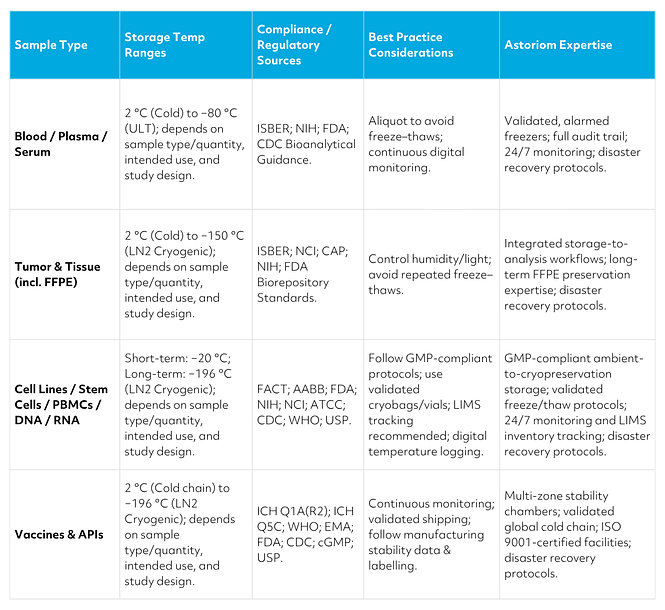
Best practice is not one-size-fits-all. Each sample type and development stage demands tailored storage, regulatory oversight, and risk mitigation. The Astoriom Sample Storage Resources Guide provide a high-level framework of critical considerations, distilled from regulatory agencies and best practices organizations (ISO, ICH, FDA, ISBER and other guidelines.)
Note: This table is a practical summary overview of storage temperature recommendations published by industry organizations and regulatory agencies and from the Astoriom Sample Storage Resources Guide which includes storage guidelines for organizations to evaluate and consider. For full details and links to sources, add the website URL page here or contact an Astoriom storage expert for a complimentary consultation.
Astoriom Sample Storage Resources Guide (Samples & Storage)
Quick Tip: Aliquot samples wherever possible to prevent multiple freeze–thaw cycles. This simple step avoids countless downstream failures.
Sustainable Sample Management Storage Strategies
With Net Zero targets on the horizon, organizations must rethink how they manage sample storage. Energy-intensive freezers, liquid nitrogen (LN2) facilities, and stability chambers are essential for research, but they also represent a significant environmental burden. Best practice now recognizes that outsourcing to a dedicated biorepository partner can provide a more sustainable approach: consolidating storage into efficient, large-scale facilities reduces duplication, optimizes energy use, and supports corporate ESG reporting — all without compromising sample integrity.
Best practices for sustainable biorepositories
- Right-size temperature bands and consolidate partial loads.
- Use high-efficiency ULTs and maintain gaskets/filters to preserve performance.
- Deploy continuous monitoring and analytics to reduce excursions and energy waste.
- Design geo-redundant storage to minimise risk while optimising utilisation.
- Report energy per sample and excursion metrics to drive continuous improvement.

The Value of an Integrated Sample Storage Partner
Fragmented storage strategies create hidden risks due to multiple vendors, inconsistent oversight, and duplicated infrastructure. By contrast, an integrated partnership delivers:
- Optimized quality and expertise across all sample types.
- Reduced sample transfer risks through consolidated custody.
- Centralized compliance tracking aligned with ISO, ICH, GxP, ISBER, FDA, EMA.
- Simplified project management with one accountable partner.
- Long-term cost efficiency through scalability and risk reduction.
- Protection from disasters with built-in continuity.
Quick Tip: Conduct a cost–benefit analysis of in-house vs. outsourced storage. Include hidden costs like freezer maintenance, energy usage, and staff time spent troubleshooting alarms. Many companies discover outsourcing is more economical long term.
In-house vs Outsourced Storage

Case Study: Technical Expertise Preventing Trial Failure
During stability testing, Astoriom staff observed “sweating” of a potent liquid through glass containers, which risked contaminating storage environments and exposing handlers. Astoriom advised the client to switch to more suitable packaging, avoiding product loss and safety risks.
Disaster Recovery and Business Continuity Planning
Fires, floods, cyberattacks, power failures, or human error can all destroy irreplaceable samples. A robust disaster recovery strategy must include:
- Redundancy: back-up generators, dual power feeds, mirrored LN2 vessels.
- Off-site storage: geographically distinct locations to protect against regional risk.
- Digital chain of custody: real-time telemetry, barcoding, LIMS integration.
- Rapid disaster recovery protocols: tested plans to relocate samples within hours.
Practical Tips for Resilience
- Test your disaster recovery plan annually with a “mock failure drill.”
- Keep a current list of alternative storage sites pre-approved by QA.
- Ensure LN2 supply contracts include backup vendors.
- Document every deviation, however small, to demonstrate audit readiness.
Astoriom has delivered disaster recovery for CROs, CDMOs, and pharma with zero sample loss. We offer dedicated disaster recovery and business continuity services backed by ISO 9001-certified infrastructure, 24/7 monitoring, and geographically distributed facilities.
Case Studies: Disaster Recovery
Equipment Failure: A client had filled its stability rooms to capacity with no redundancy and no service contracts in place. When both cabinets failed simultaneously, the client faced imminent loss of critical material. Astoriom arranged urgent transport, revalidated storage conditions, and long-term backup storage, stabilizing the situation.
In Action: A global CRO experienced a sudden failure of a 5 °C walk-in stability room, placing thousands of client samples at immediate risk. Astoriom activated its disaster recovery service, organizing controlled collection, validated transport, and rapid transfer into compliant storage conditions.
Global Risk Mitigation: A US-based biotech in California chose to store materials in Astoriom’s UK site to avoid risks from wildfires, earthquakes, and other regional hazards. Although this required international logistics, the company valued the geopolitical and environmental stability of Astoriom’s facilities.
Benchmarking Metrics for Biorepository Sample Storage Excellence
- Freezer uptime (% of time operational)
- Number of temperature excursions detected and resolved
- % of samples with complete chain-of-custody records
- Audit readiness scores from internal and customer QA
- Full audit trail 21 CFR Part 11
- Energy usage per sample stored
- Disaster recovery drill success rate
- Disposition completion rate
Hybrid model: Core customer employees (FTE) working hand-in-hand with Astoriom strategic infrastructures and experts supporting oversight and continuous improvement. Astoriom provides transparent KPI reporting to clients, supporting oversight and continuous improvement.
Choosing a Sample Storage Solutions Partner to Protect Research Assets from Discovery to Post-Market
Every sample represents investment, patient trust, and the promise of innovation. To protect that promise, life science companies must embrace integrated, compliant, and sustainable storage strategies. A dedicated sample storage and stability partner is often the solution, offering faster turnaround times, improved business continuity assurance and flexibility to scale without heavy capital investment.
Checklist for choosing a storage partner
- Can they provide validated storage across all temperature ranges?
- Do they comply with ICH, GxP, ISBER, FDA, and ISO standards?
- Is disaster recovery built-in, with redundant off-site capacity?
- Can they scale with your pipeline, from preclinical to commercial?
- Do they integrate sustainability and energy efficiency?
Why Astoriom is the Partner of Choice
- 30+ years of sample storage expertise safeguarding samples for pharma, biotech, and medical device companies.
- Global footprint across the US, UK, and Ireland.
- Comprehensive coverage of all storage conditions, from ambient to cryogenic (−196 °C).
- Regulatory excellence across ICH, FDA, EMA, MHRA, ISO, and ISBER.
- Proven Quality Systems, GxP sample storage compliance and zero sample losses due to built-in redundancy and monitoring over past three decades of operation.
- Trusted by pharma, biotech, and medical device leaders worldwide.
- 24/7 sample tracking and reporting: Automated LIMs system, storage alarms and security alerts
Astoriom has delivered disaster recovery for CROs, CDMOs, and pharma with zero sample loss. We offer dedicated disaster recovery and business continuity services backed by ISO 9001-certified infrastructure, 24/7 monitoring, and geographically distributed facilities.
The value of partnering with Astoriom is our over 30 years of experience and proven, real-world success in delivering integrated, compliant and scalable biorepository and stability storage solutions, disaster recovery resilience solutions and expert service & validation technicians.
Safeguard Every Sample — Partner with Astoriom
Need validated, compliant biorepository and ICH stability storage across CRT, 2–8 °C, −20 °C, −80 °C and LN2 vapor? Our global team can help.