


Why Yesterday’s Storage Plan Isn’t Built for Today’s Pipeline
At BPI Boston 2026, Astoriom’s Lori A Ball, President of Strategic Endeavors, explored a growing challenge facing the biopharmaceutical industry: as sample collections become larger, more complex, and increasingly irreplaceable, traditional approaches to storage continuity are no longer sufficient.
The Cost of Getting It Wrong
Biopharma organizations invest years of research, development, and clinical testing into generating critical biological samples. Yet many storage strategies still rely on models developed when collections were smaller, geographically concentrated, and easier to replace.
The reality today is very different. Biological materials are often distributed across multiple locations, tied to complex global clinical trials, and subject to increasing regulatory scrutiny. When a storage failure occurs, the impact extends far beyond lost inventory. It can delay programs, trigger compliance concerns, compromise research continuity, and in some cases result in the loss of irreplaceable scientific data.
Why the Risk Landscape Has Changed
A key theme of the presentation was that sample storage risk has evolved faster than many continuity plans.
Three factors are driving this shift:
- Samples are increasingly irreplaceable and difficult to recollect.
- Global operations have created more distributed collections with fragmented ownership and oversight.
- Regulatory authorities and auditors expect greater evidence of control, traceability, and resilience.
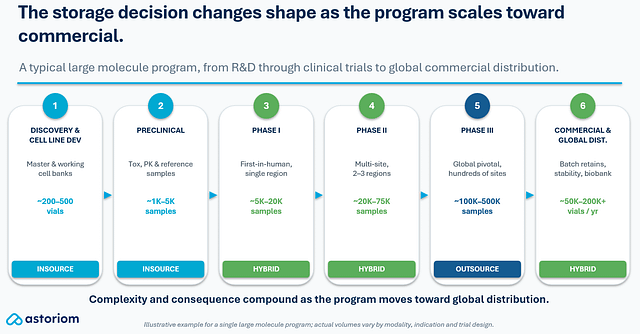
As programs expand from early-stage development through Phase III clinical trials and commercial manufacturing, both sample volumes and operational complexity grow significantly. What may have been an acceptable storage approach in discovery or preclinical phases can become a substantial risk by the time a program reaches global scale.
The Weak Links in Traditional Storage Models
Many organizations continue to depend on:
- Single-site storage strategies
- Manual or periodic monitoring
- Fragmented inventory visibility
- Recovery plans that have never been tested under real-world conditions
The issue is rarely a people problem. Instead, it is often the result of infrastructure and processes that were not designed for today’s risk environment.
Building a Modern Risk Mitigation Framework
The presentation highlighted four interconnected capabilities that form the foundation of a resilient sample protection strategy:
Continuous Monitoring – Real-time visibility helps identify issues before they escalate into sample loss events.
Sample-Level Inventory Intelligence – Accurate inventory data enables organizations to understand what is stored, where it is located, and how collections are protected.
Geographic Redundancy – Separating critical collections across locations reduces dependence on a single site and lowers the risk of catastrophic loss.
Tested Disaster Recovery – Recovery plans should not simply exist on paper. They should be regularly tested and proven before an incident occurs.
As Lori noted during the presentation, modern protection comes not only from the freezer itself, but from the infrastructure, processes, and recovery capabilities that surround it.
Planning for Scale Before It Becomes a Problem
One of the most compelling discussions focused on the importance of aligning storage strategy with the lifecycle of a biopharmaceutical program.
Organizations that assess storage, redundancy, and disaster recovery requirements early can scale confidently as collections grow and regulatory expectations increase. Those that delay these decisions may introduce operational risks that only become visible when programs reach later clinical phases.
The presentation used industry-based composite scenarios to demonstrate how proactive planning, distributed storage, continuous monitoring, and tested recovery strategies can help organizations avoid costly disruptions while maintaining compliance and protecting high-value pipeline assets.
The Takeaway
Modern risk mitigation is no longer simply about storage capacity or temperature control. It is about creating visibility, resilience, and recoverability across every critical sample collection.
For biopharma companies managing valuable research materials, clinical trial samples, cell banks, stability samples, and biorepository collections, the question is no longer whether continuity planning is needed, but whether current plans are built for the realities of today’s pipeline.
Request the Full Presentation
If you missed the session at BPI Boston or would like to explore the topic in more detail, Astoriom can provide the full presentation and discuss the practical strategies organizations are using to strengthen sample protection, improve business continuity, and reduce storage-related risk.
Contact our team to request a copy of the presentation or schedule a conversation about your sample storage, disaster recovery, and continuity planning requirements.
About Astoriom: For more than 30 years, Astoriom has provided the highest quality, ICH sample stability and storage solutions to R&D industries. We have expanded our offerings to include comprehensive sample storage equipment and validation services and disaster protection and recovery solutions.
Our R&D customers come from over 20 industries, including biopharmaceutical, biotechnology, medical device and consumer products. They trust us to secure, protect and preserve their scientific research and consumer product samples. We have a relentless focus on quality and dedication to partnering with our customers to deliver the highest quality sample stability and storage solutions. Our global, state-of-the-art facilities around the world adhere to international quality compliance standards.
Get in touch to find out how we can support your storage needs.


