


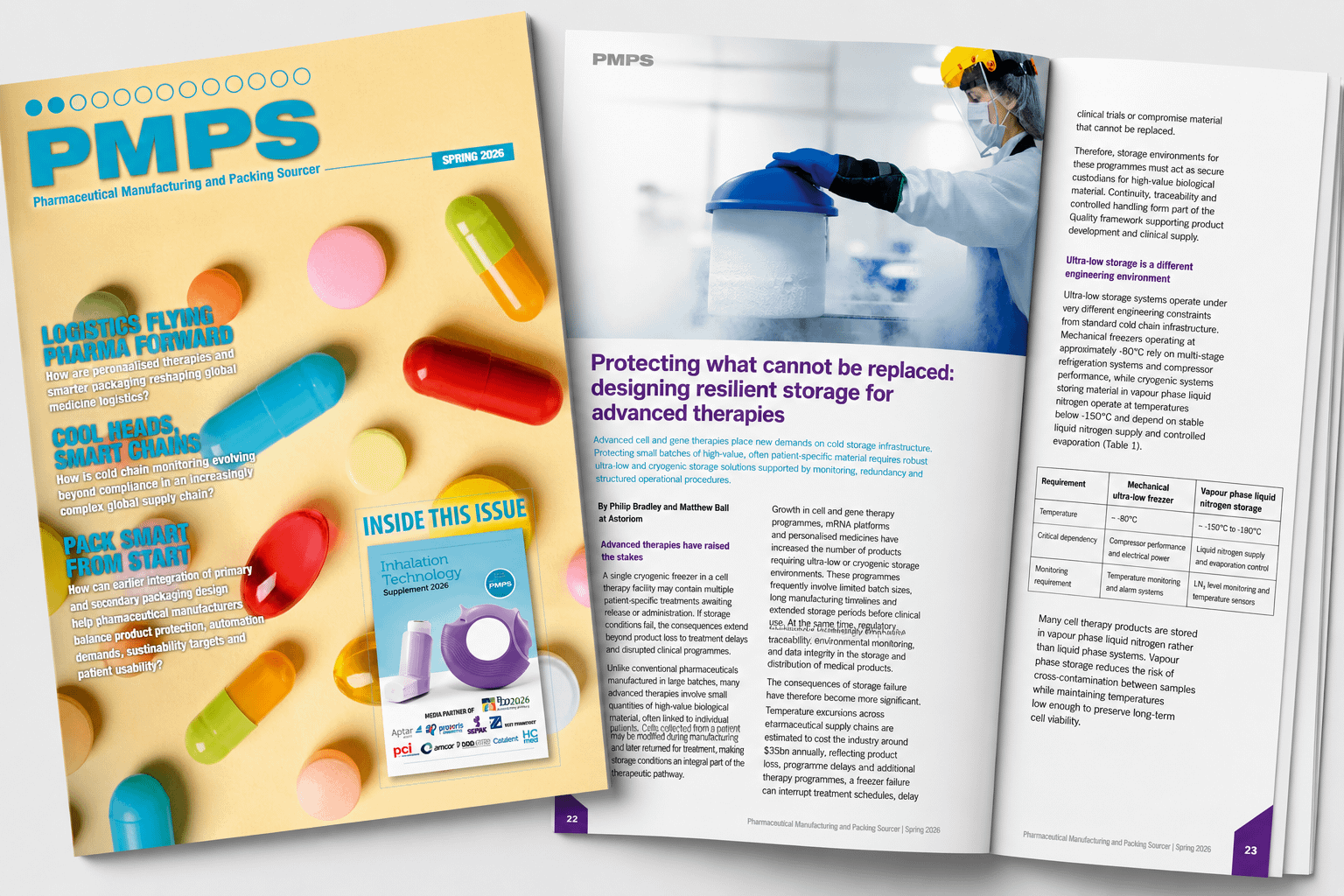

Advanced cell and gene therapies place new demands on cold storage infrastructure. Protecting small batches of high-value, often patient-specific material requires robust ultra-low and cryogenic storage solutions supported by continuous monitoring, engineered redundancy and structured operational procedures.
This is an abridged version of an article originally published in Pharmaceutical Manufacturing and Packing Sourcer, Spring 2026, pages 20-23. © Samedan Ltd. Read the full publication here: https://www.calameo.com/read/006113385854dbddf28a9?page=20
Advanced therapies have raised the stakes
A single cryogenic freezer in a cell therapy facility may contain multiple patient-specific treatments awaiting release or administration. If storage conditions fail, the consequences extend far beyond product loss to treatment delays, disrupted clinical programmes and the potential loss of irreplaceable biological material.
Unlike conventional pharmaceuticals manufactured in large batches, many advanced therapies involve small quantities of high-value material linked to individual patients. Cells collected from a patient may be modified during manufacturing before being returned for treatment, making storage conditions an integral part of the therapeutic pathway.
The rapid growth of cell and gene therapies, mRNA platforms and personalised medicines has significantly increased demand for ultra-low and cryogenic storage. At the same time, regulatory expectations continue to place greater emphasis on traceability, environmental monitoring and data integrity throughout the storage and distribution process.
Temperature excursions across pharmaceutical supply chains are estimated to cost the industry billions of dollars annually through product loss, programme delays and additional investigations. For advanced therapies, the impact can be even greater, interrupting treatment schedules, delaying clinical trials or compromising material that cannot simply be replaced.
Ultra-low storage requires specialist engineering
Ultra-low storage systems operate under very different engineering constraints from conventional cold chain infrastructure. Mechanical freezers operating at approximately -80°C rely on multi-stage refrigeration systems and compressor performance, while cryogenic storage operating below -150°C depends on stable liquid nitrogen supply and controlled evaporation.
Each system presents different failure modes and monitoring requirements. Mechanical systems may be vulnerable to compressor failure or refrigerant loss, whereas cryogenic storage requires reliable monitoring of liquid nitrogen levels and vapour conditions. Facilities storing sensitive biological material should therefore implement validated monitoring systems capable of rapidly detecting deviations and initiating a controlled response.
Many cell therapy products are stored in vapour phase liquid nitrogen rather than liquid phase systems, reducing the risk of cross-contamination while maintaining temperatures that preserve long-term cell viability.
Thermal behaviour also changes significantly at these temperatures. Although ultra-low storage environments provide a limited intervention window following equipment failure, the rate of temperature change depends on freezer design, loading density and storage configuration. Continuous environmental monitoring, calibrated sensors and validated alarm thresholds are therefore essential.
Living cell products are particularly sensitive to temperature fluctuations, with even short deviations capable of affecting cell viability and therapeutic potency. Sample handling also plays an important role in maintaining product integrity, with practices such as aliquoting helping to minimise repeated freeze-thaw cycles that can damage sensitive biological material.

Building resilience beyond compliance
Regulatory compliance alone does not guarantee continuity during disruption. Designing resilient storage environments requires both engineered redundancy and operational readiness.
Resilient facilities typically incorporate layered redundancy across critical infrastructure. Electrical systems may include N+1 or 2N capacity depending on the risk profile of stored material, while backup generators and automatic transfer systems maintain environmental control during power interruptions. Environmental monitoring systems operate continuously, generating alerts whenever equipment or temperature conditions move outside predefined limits, with escalation procedures ensuring deviations receive immediate attention.
Operational procedures are equally important. Standard operating procedures define actions during equipment failure, power interruption or environmental deviation, while personnel training ensures staff understand both the technical infrastructure and the required response. Routine testing of backup systems and emergency procedures provides confidence that contingency plans will function effectively when needed.
Resilience ultimately depends on the interaction between infrastructure design, monitoring technology and operational discipline rather than any single technical solution.
Maintaining chain of identity and custody
Temperature control represents only one element of secure storage for advanced therapies. Many programmes require strict traceability throughout the entire storage lifecycle.
For patient-specific therapies, biological material must remain associated with the correct patient from collection through manufacturing, storage and final administration. Storage environments therefore need to support robust segregation, accurate labelling and reliable tracking systems.
Facilities should incorporate controlled access, documented custody procedures and electronic audit trails. Environmental monitoring systems can link temperature records directly to storage locations or individual samples, creating a complete history of storage conditions throughout development and clinical supply.
Supporting data systems must also comply with regulatory expectations governing electronic records and data integrity, ensuring information remains attributable, secure and inspection ready.
Disaster recovery is fundamental
Storage systems are ultimately judged by their performance during disruption. When equipment fails or power is lost, organisations have only a limited window to prevent temperature excursions and protect valuable material.
A widely reported incident in 2023 demonstrated the consequences of inadequate monitoring when multiple cryogenic storage tanks failed after liquid nitrogen supplies were not replenished and alarm notifications were missed. More than 47,000 biological samples were lost, with investigations concluding that the incident resulted from a combination of unclear responsibilities, ineffective alarm management and delayed intervention rather than a single technical failure.
Events such as this reinforce the importance of resilient monitoring systems, clearly defined escalation pathways and regularly tested contingency procedures.
Effective disaster recovery planning extends beyond monitoring alone. Facilities should maintain predefined emergency procedures covering equipment failure, power loss and facility incidents, supported by qualified transfer containers, secondary storage capacity and established transport arrangements that allow material to be relocated under controlled conditions whenever required. Routine testing of disaster recovery procedures, including simulated failure scenarios, provides assurance that contingency plans remain operationally effective.
Storage as strategic infrastructure
Advanced therapies and biologics often require long-term storage throughout extended development programmes, stability studies and clinical trials. As programmes progress, storage requirements become increasingly complex, requiring careful capacity planning, validated environmental monitoring and robust change control throughout the product lifecycle.
“Storage strategies must also evolve across the development lifecycle.”
Alongside engineering design, reliable storage operations also depend upon trained personnel and clearly defined operational procedures. Monitoring systems identify deviations, but effective human intervention determines how successfully those deviations are managed. Structured alarm management, ongoing training and continuous review all contribute to organisational preparedness.
For advanced cell and gene therapies, storage infrastructure should be viewed as a strategic component of the therapeutic supply chain rather than simply a temperature-controlled environment. Organisations evaluating storage solutions increasingly consider infrastructure resilience, monitoring architecture, data integrity and contingency capability alongside storage capacity.
As advanced therapies continue to expand, resilient storage environments will remain fundamental to protecting irreplaceable biological material. Designing storage infrastructure with the same rigour applied to manufacturing, quality and logistics is therefore essential to ensuring these innovative therapies remain protected throughout development and clinical use.
About the authors: Philip Bradley is the general manager at Astoriom, bringing nearly a decade of experience within the life sciences industry. Specialising in stability storage services, Philip oversees operations across Astoriom’s global locations and his role is crucial in maintaining the company’s commitment to quality and customer satisfaction.
Matthew Ball is the site manager at Astoriom Rochdale, bringing over two decades of experience spanning research operations, GMP facility leadership, and cross-functional site management. His background includes over ten years at the University of Manchester, UK where he helped establish and run the Protein Expression Core Facility.
About Astoriom: For more than 30 years, Astoriom has provided the highest quality, ICH sample stability and storage solutions to R&D industries. We have expanded our offerings to include comprehensive sample storage equipment and validation services and disaster protection and recovery solutions.
Our R&D customers come from over 20 industries, including biopharmaceutical, biotechnology, medical device and consumer products. They trust us to secure, protect and preserve their scientific research and consumer product samples. We have a relentless focus on quality and dedication to partnering with our customers to deliver the highest quality sample stability and storage solutions. Our global, state-of-the-art facilities around the world adhere to international quality compliance standards.
Get in touch to find out how we can support your storage needs.


